Reveal assumptions, reveal intention
Some days, I feel like I conduct all interactions peeking through a keyhole. I try to extract meaning from what I receive through this tiny window. Things aren’t exactly distorted, but, they’re difficult to truly comprehend. Whether you feel like I do or not, my keyhole experience probably depicts how much we can understand another person’s intentions based on their actions, especially if one or both of you is neurospicy.
Asking partners
Do you ever tell yourself that asking takes effort, so you may as well do it yourself? The more I sucked it up and took care of the little things my husband left behind, the more resentful I became. So I stopped. I began to ask questions. I didn’t ask him to clean up what he’d left. No matter how phrased, a reminder is not a question. I asked about intention.
Things began to change. One day, I noticed that it had been a long time since I’d found little pieces of plastic and paper packaging on the counters, so I put on my housekeeping detective hat and asked my husband why counter trash had stopped. He explained that he really wanted to avoid my asking him:
Are you leaving this for me?
He said he never left trash behind as an aggressive act. It was just a step among many other steps that he didn’t think about. My question revealed that the trash sent a message and weighed on me. He didn’t want me to think he expected me to take care of it, so he changed his behavior.
I’m not sure how the phrasing “are you leaving this for me?” came about. I asked it calmly. I wanted to know: Is this mine to carry? Is it left with intention? The “no” relieved me of the burden of responsibility and resentment, and I would go on with my day.
Asking the intention changed the dynamic. I wasn’t giving a reminder to a grown man or asking an adult to clean up their own mess as a favor to me. The question drew attention beyond the immediate problem to the pattern. When we see our behavior as a pattern, we are more likely to change it.
Asking kids
It can be difficult to pause before we assign our grownup narrative to child behaviors. My husband tells a childhood story about the time his mother lectured him about sloshing bathwater onto the floor. As he listened, he discovered how to play with his focus, watching two mommies get onto him. His mother saw him crossing his eyes at her in mockery, and lost her temper. He hadn’t yet made the connection that she could see his eyes change focus and what it looked like on the outside.
My child is not ordinarily disrespectful, so I’ve learned to wait a beat when he says or does something that seems really inconsiderate, and ask him why, as calmly as I can. He is so accustomed to this question, that he receives it and answers calmly, without defensiveness. It turns into a conversation, even in those rare times when he really was inconsiderate. The why reveals the behavior, so he is accountable instead of accused.
As parents, we need to be the one to assume the best of our child’s intentions. When we don’t, they feel this deeply. This is why I try very hard to ask why before I react. Kid brains, ‘spicy or not, function differently than ours.

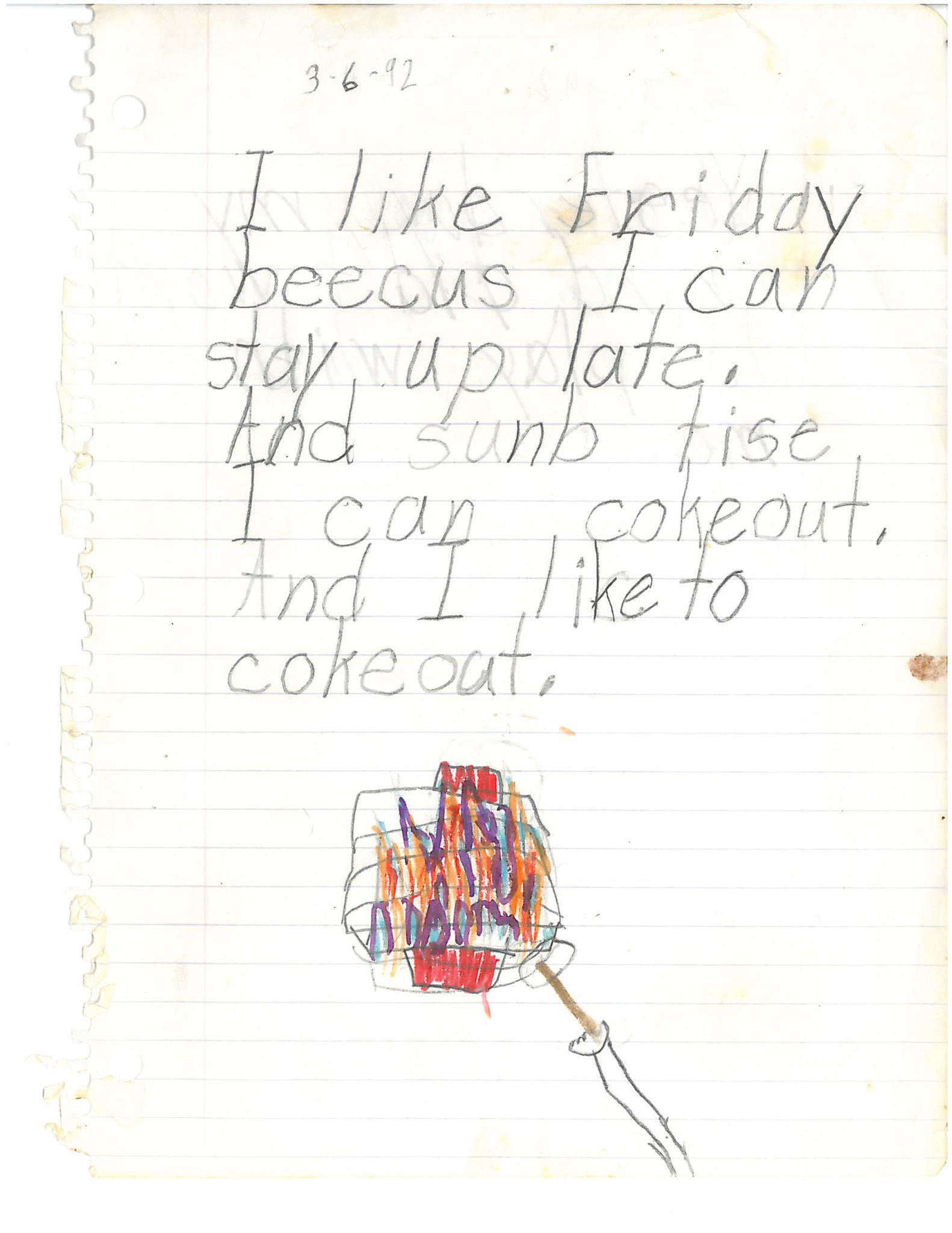
This artwork I drew in the 1st grade highlights the importance of asking questions before assuming our adult narrative. Also, can you tell how much little kid me stared into the fire?
Back then, hearing aids were analog, amplifying everything equally, with no regard to the slope of one’s audiogram. I think this accounts for my unique sounding out.
My spelling vastly improved a couple of years later. In 1993, all new TVs had to be closed captioning capable, and my mom got one. The Americans with Disabilities Act passed in 1990, and TV manufacturers had 3 years (from kinder to 3rd grade) to get their act together. If that hadn’t happened at that time in our history, I’m not sure I’d be much of a writer today. I always tell friends whose kids are having a hard time with spelling and reading to turn on the CC. Accessibility has a way of helping everyone.


Today was hot. An LA winter heat wave with a high of 99. C came in while I made dinner. “What’s for dinner?” He asked. “Different stuff,” I said. “I like different stuff,” said C. We had raw broccoli with a sour cream dip. I wanted to make ranch dip, but I only found a seasoning packet for fettuccine, so I shrugged and sprinkled that in. For salad, the last of some cabbage, which I mixed with mayo, mustard and a dollop of green salsa to approximate coleslaw. The extent of my cooking was 4 pieces of toast. Half, topped with mashed avocado, the other half with cream cheese with sliced baby tomatoes.

Last Friday, I shared Part 2: Internalized Audism.

Discover more from Neurospicy Housekeeping
Subscribe to get the latest posts sent to your email.