About Me
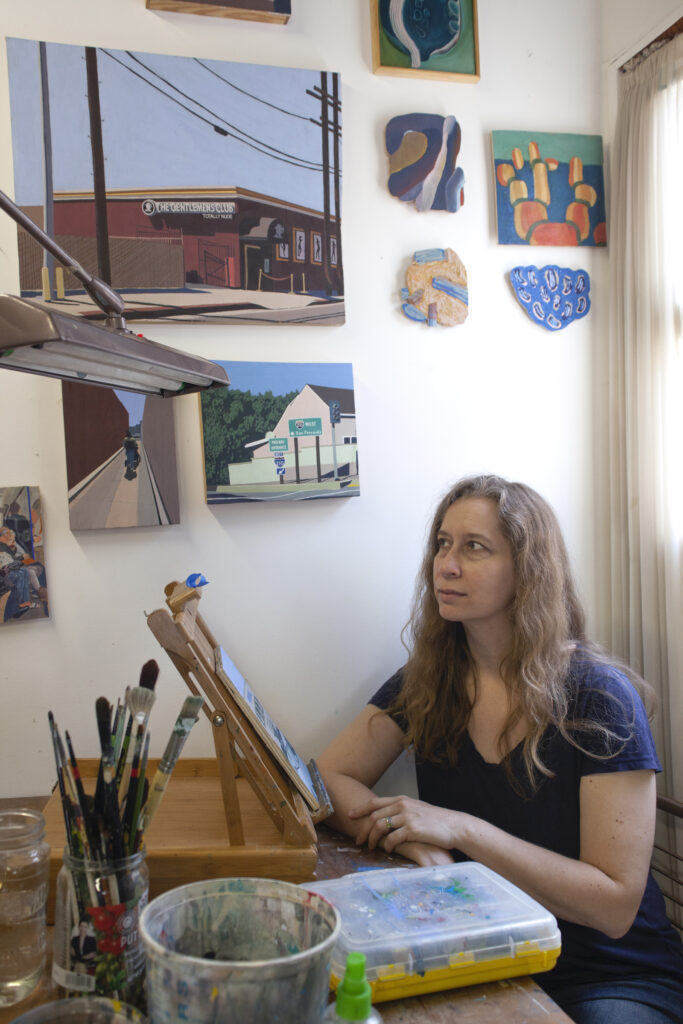
When I was 13 I started writing to help make sense of the world around me. I would rewrite my entire day as a way to process it. I also wrote random weird kid stuff in there, too, of course. Later, I wrote for the school paper, and as a teen journalist for the Fort Worth Star Telegram. I ended up studying art in college, and for 20 years I have been a painter of Los Angeles scenes and infrastructure. After college, I came up with a design for a handheld printmaking press kit, and started printmakingpress.com. True to my ‘spicy ways, I also do graphic design and web design. My other hustles include designing fabric that I sew into kitchen towels, creating sewing and paper patterns, and drawing child and pet portraits. I also do some cleaning and pet sitting because times right now are tough. I live in a very small house in an LA County suburb with my husband, child and dog. It is not a wild farmhouse, but I pretend it is.
My Newsletter
There was this brief period when my writing really made sense for me. I had an online journal called a Xanga. I connected with others deeply, overshared, and made a lifelong friendship with a Hobbit from Oklahoma. Decades later, I watched a video on Kanopy that showed me how a newsletter could bring me back to this space where my writing self exists naturally. The video was Skillshare’s video on newsletters by Cody Cook-Parrott. I watched it because newsletters had never made any sense to me and with my book coming out in 2028, I figured I should learn. Cody’s perspective on newsletters and the way they share their quietly rich inner life showed me that I don’t have to wait years between books to share myself. A newsletter could be a space for self expression, which I love, and not marketing, which I avoid.
My Lens
I look at the neurodiverse experience a little differently because I also grew up with a disability. As a “hearing impaired” kid with an oral only upbringing I see overlap in how hard of hearing and neurodiverse people are treated, and how we feel. Invisible disabilities and differences aren’t seen, and in social interactions, people assign negative reasons for our behavior. They become frustrated and angry, and we take this on. Like neurodiverse people, hard of hearing people sting from lack of understanding and accommodation, until they meet Deaf Culture. In Deaf Culture, we learn to be proud of our deafness, to own the word deaf instead of “impaired”. We learn about Deaf gain, which is the unique way we experience the world because of our difference. I see being uniquely wired through this lens, as another expression of humanity equally rich and interesting. This is why my tone is always curious and accepting, though my lived experience has made it a bit playful and wry.